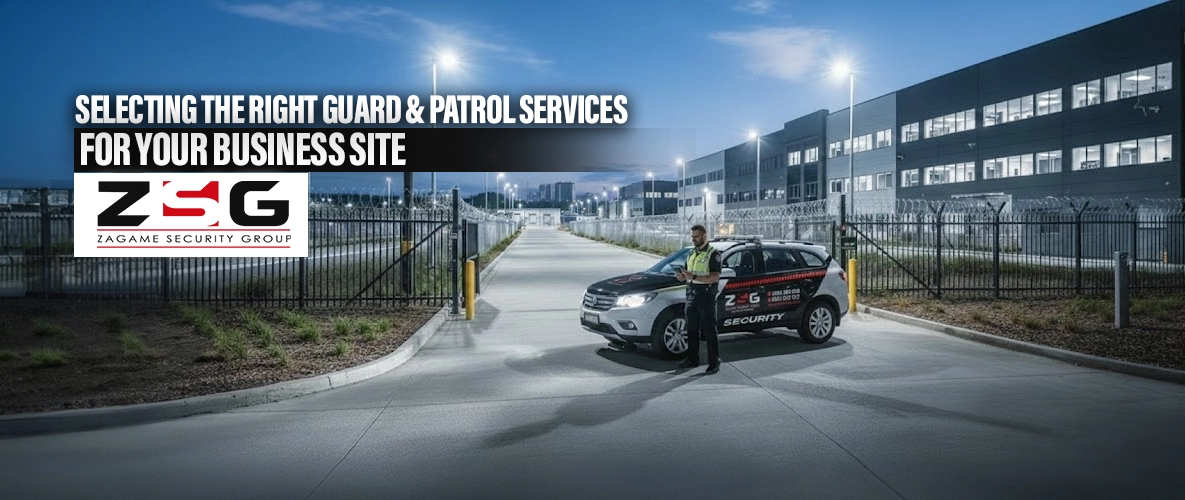
Many businesses underestimate how critical the human element is in physical security. While alarms, cameras and lighting matter, it is the disciplined guard, the responding mobile patrol and the human logic behind protocols that often make the difference. At Zagame Security Group, we specialise in business-focused guard and patrol services. In this article we’ll walk you through: understanding when guards/patrols are needed, what to look for in a provider, defining service levels, and how to integrate them into your business operations.
When do you need guards or mobile patrols?
Here are common scenarios where a business should seriously consider guards or patrols:
- High-risk access points: If you have large shipments, high value goods, or late-night operations (warehouses, logistics hubs) an onsite guard reduces risk and response delays.
- After-hours sites: Businesses that operate outside standard hours (construction sites, entertainment venues, factories) benefit from visible security presence.
- Remote or isolated locations: If your business site is in an industrial estate, bush-fringe area or low-traffic zone, patrols or guards offset the risk of delayed law-enforcement response.
- Multi-entry sites with many staff/contractors: A guard helps manage access, verify identities, monitor subcontractors and maintain logs.
- Vulnerable businesses: Such as casinos, entertainment venues, chemical/ hazardous materials sites, or businesses with previous security incidents.
- As part of a broader deterrence strategy: Seeing a uniformed guard or regular patrol vehicle signals to criminals that the site is protected.
What to look for in a guard/patrol service provider
When selecting a provider (such as Zagame Security Group), consider the following criteria:
- Commercial/business focus
The provider should specialise in business and industrial sites — not just residential. Zagame has decades of experience focusing on commercial, industrial and retail clients. LinkedIn
- Qualified personnel & training
Guards must be trained, licensed, alarm-response competent, patrol-round capable, with documented protocols. Ask how the provider handles staffing, training and refreshers. - Mobile patrol capability & response times
The provider should offer incident response, randomised patrols, CCTV-linked patrol triggers, and reporting. Guards alone may not suffice if the site is large and spread out. - Effective communication & reporting
Regular reporting, incident logs, access logs, CCTV link-ups, guard notes, digital check-in/out systems and management reviews are key. Make sure you get meaningful metrics. - Scalable service and integration
As your business grows, or as your risk profile changes (e.g., new shift patterns, higher value stock, extended hours), your security service should scale accordingly. Ask about the ability to integrate with your alarm monitoring, access control, lighting and business-continuity plans. - Strong local presence & proven track record
A security provider with strong regional capability, quick-response resources and reputation for reliability adds value. Zagame Security Group operates across multiple states and has commercial experience.
Defining your service levels and contracts
Once you’ve selected a provider, you’ll need to define what service level you require.
Key items to specify:
- Guard hours: e.g., 24/7 onsite, nights only, weekend coverage, special event shifts.
- Mobile patrol frequency: e.g., hourly checks after hours, randomised patrols, triggered patrols post-alarm.
- Response times: For guard dispatch, mobile patrol activation, alarm response.
- Patrol routes and logs: Specifying which zones are covered, how often, path randomisation vs standard runs, documentation.
- Incident handling and escalation: What happens when a guard or patrol finds an issue (unauthorised access, alarm activation, break in)? How is law enforcement involved? Who notifies your business?
- Access control and visitor management: Are guards managing access gates, sub-contractor entries or verifying credentials?
- Regular reviews and audits: At what intervals will performance, guard logs, incident history and service levels be reviewed?
- Integration with other services: For example, combining guard/patrol with your alarm monitoring, CCTV review, lighting checks, and business-continuity activation.
Common pitfalls and how to avoid them
- Guard presence only, no monitoring or patrols: A static guard may deter, but without mobile patrols or integrated monitoring, blind spots or shift downtime may be exploited.
- Assuming one size fits all: Every site is different. A warehouse with large external yards needs different service than a small office-block lobby. Tailor the solution.
- Neglecting after-hours protocols: Many incidents occur after standard business hours — make sure guard/patrol service covers these times, and your provider has robust after-hours procedures.
- Poor documentation and lack of KPIs: If the guard provider does not supply incident logs, patrol records and performance reviews, you lack visibility into how your investment is performing.
- Not integrating with business operations: Security shouldn’t be siloed. If your guards/patrols aren’t aware of your business processes (deliveries, contractors, shutdowns, events), you lose value.
How Zagame Security Group works for you
At Zagame Security Group we tailor guard and patrol services specifically for business sites (not residential). Here’s how we deliver value:
- We begin with a comprehensive site survey — reviewing risk, access points, hours of operation, staffing, inventory levels, previous incident history and external environment.
- We recommend the optimal mix of guards and mobile patrols, aligned with your business hours, high-risk zones and response requirements.
- We integrate our guard/patrol services with our alarm monitoring and asset protection offerings — so you get a unified security solution.
- We provide digital reporting, incident logs, patrol check-ins, management dashboards and periodic review meetings to ensure service quality.
- We adjust services as your business evolves — new facilities, new risks, new hours, we adapt.
Getting started – action plan
Step 1: Define your business requirements — what hours do you operate, which areas are high-risk (loading dock, warehouse, access gate), what is your asset value, how many people on site after hours?
Step 2: Request a site survey from Zagame Security Group (or your preferred provider) for guard/patrol coverage and integration with your overall security plan.
Step 3: Review the proposed service levels, KPIs, patrol logs, response times, guard shift roster and contract terms.
Step 4: Launch the service and ensure your internal team (facilities, operations, management) is briefed on how guards/patrols fit into the overall security protocol.
Step 5: After 90 days, review performance: number of incidents detected, false alarms, patrol inconsistencies, staff feedback, logs — and adjust service levels if needed.
In the realm of business physical security, human presence still matters. A well-trained guard and a smart mobile patrol service are potent deterrents, detection tools and response enablers. By selecting the right provider, defining your service levels, integrating with your operations and reviewing performance regularly, your business can significantly raise its security posture. If you’d like to discuss how Zagame Security Group can design a guard and patrol program tailored to your site, please contact us.